Functional Medicine vs Naturopath: What’s the Difference
- Functional Medicine
- Share this post on:
- Share this post on:
Post Contents
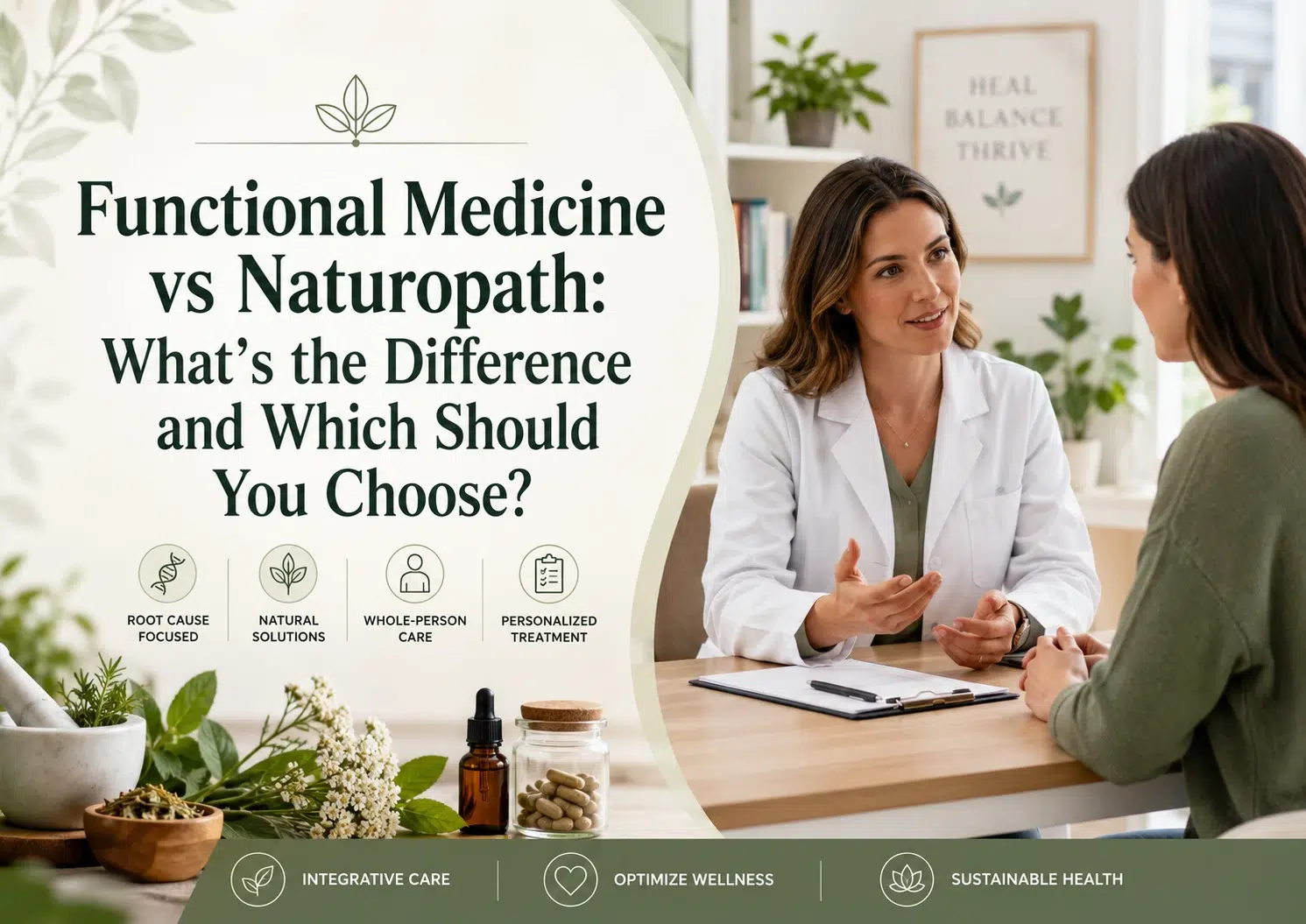
When comparing functional medicine vs a naturopath, the main difference is that functional medicine is a clinical approach, while naturopathic medicine is a distinct healthcare discipline.
Both may consider nutrition, sleep, stress, physical activity, environmental exposures, and other factors that influence health.
However, the provider’s education, professional license, testing methods, treatment options, and ability to prescribe medication may be very different.
Understanding those differences can help you choose a provider whose qualifications and approach match your needs.
SEE HOW FUNCTIONAL MEDICINE CAN HELP YOU
Functional Medicine vs Naturopath: The Quick Answer
Functional medicine is an approach used by professionals with different healthcare backgrounds, including physicians, nurse practitioners, dietitians, chiropractors, and naturopathic doctors.
Naturopathic medicine has its own educational pathway and treatment philosophy.
Both may use nutrition and lifestyle changes, but their credentials, diagnostic authority, treatments, and prescribing abilities can differ.
Functional Medicine vs Naturopathic Medicine at a Glance
| Category | Functional Medicine | Naturopathic Medicine |
| What it is | A clinical framework or approach | A distinct healthcare discipline |
| Who may provide it | Physicians, nurse practitioners, naturopathic doctors, dietitians, chiropractors, health coaches, and other trained professionals | Accredited naturopathic doctors, traditional naturopaths, and other providers offering naturopathic services |
| Main focus | Examining how body systems, lifestyle, genetics, and environmental factors may relate to symptoms | Supporting health through naturopathic principles and natural-first therapies |
| Common assessments | Detailed health history, standard medical testing, and selected specialized testing | Detailed health history, nutrition evaluation, physical assessment, and testing where legally permitted |
| Common treatments | Nutrition, exercise, sleep support, stress management, supplements, medication, and other therapies within the provider’s scope | Nutrition, botanical products, supplements, lifestyle changes, physical medicine, and other naturopathic therapies |
| Prescribing authority | Determined by the practitioner’s underlying professional license | Depends on the practitioner’s credentials and state law |
| Regulation | Based primarily on the provider’s original licensed profession | Naturopathic licensing varies by state |
| Insurance coverage | Depends on the provider, service, practice model, and insurance plan | Depends on state recognition, provider credentials, service, and insurance plan |
What Is Functional Medicine?
Functional medicine is a patient-centered approach that examines how different parts of a person’s health may be connected.
Instead of viewing each symptom as a completely separate issue, a functional medicine provider may look for patterns involving digestion, metabolism, hormones, immune function, sleep, stress, nutrition, and daily habits.
An evaluation may include questions about:
- Current symptoms
- Previous diagnoses and treatments
- Medications and supplements
- Eating habits
- Sleep quality
- Physical activity
- Stress levels
- Family history
- Environmental exposures
- Changes in symptoms over time
The purpose is to build a broader picture of the patient’s health and identify factors that may be contributing to their concerns.
The term functional medicine practitioner does not identify a specific degree or professional license.
Functional medicine can be incorporated into the work of professionals with many different backgrounds.
Completing functional medicine training does not expand what someone is legally allowed to diagnose, prescribe, or treat.
A physician practicing functional medicine, for example, has a different scope of practice from a health coach who has completed functional medicine education.
The provider’s original credentials remain important.
What Is Naturopathic Medicine?
Naturopathy, also called naturopathic medicine, is a healthcare discipline that emphasizes prevention, healthy living, patient education, whole-person care, and support for the body’s natural processes.
Depending on the provider’s education and the laws where they practice, naturopathic care may involve:
- Nutrition counseling
- Exercise recommendations
- Sleep and stress support
- Botanical or herbal products
- Vitamins and dietary supplements
- Physical medicine
- Hydrotherapy
- Other complementary therapies
The services offered can vary considerably.
Some naturopathic doctors have completed accredited graduate-level education, while traditional naturopaths may have completed programs with different lengths, standards, and clinical requirements.
Because of this variation, the terms naturopath, naturopathic practitioner, and naturopathic doctor do not always mean the same thing.
Naturopath vs Naturopathic Doctor: Does the Title Matter?
Yes.
A naturopathic doctor and a traditional naturopath may have very different levels of education and clinical training.
An accredited naturopathic doctor generally completes a four-year graduate program at a school recognized by the Council on Naturopathic Medical Education.
Graduates may use the degree ND, meaning Doctor of Naturopathy, or NMD, meaning Doctor of Naturopathic Medicine.
A traditional naturopath may complete a non-accredited program that varies in length and content.
This type of education does not necessarily qualify the person for naturopathic physician licensing.
Even when someone has earned an accredited ND or NMD degree, their legal authority depends on the state where they practice.
Some states license naturopathic doctors and clearly define what they may diagnose, prescribe, or perform.
Other states do not recognize naturopathic medicine as a separately licensed profession.
Before receiving care, ask about:
- The provider’s degree
- Where the degree was earned
- Whether the school was accredited
- The provider’s current professional license
- What services the provider may legally offer in your state
A title on a website does not always reveal what someone is qualified or legally permitted to do.
Are Functional Medicine and Naturopathic Medicine Evidence-Based?
Neither label guarantees that every recommended test or treatment is supported by strong evidence.
The evidence should be evaluated for each specific recommendation, including:
- Laboratory tests
- Elimination diets
- Vitamins and supplements
- Botanical products
- Prescription medications
- Exercise plans
- Stress-management techniques
- Other complementary therapies
Some recommendations, such as improving sleep, increasing physical activity, addressing nutrient deficiencies, and managing established medical conditions, may have strong support when used appropriately.
Other specialized tests, supplement protocols, or restrictive diets may have limited or mixed evidence.
A qualified provider should be able to explain why a test or treatment is being recommended, what evidence supports it, and how it will affect the care plan.
How Are Functional Medicine and Naturopathy Similar?
Functional medicine and naturopathic medicine often overlap, which is why the terms are sometimes confused.
Both approaches may emphasize:
- Whole-person care
- Prevention
- Patient education
- Nutrition and lifestyle changes
- Longer health histories
- Individualized recommendations
- Sleep and stress management
- Factors that may be contributing to symptoms
Both may also use dietary supplements or complementary treatments.
However, the provider’s credentials, legal scope, clinical methods, and treatment philosophy may still be different.
What Is the Difference Between Functional Medicine and a Naturopath?
Let’s look at the main differences between functional medicine and a naturopath:
Functional Medicine Doctor vs Naturopath: Education and Credentials
Functional medicine is additional training or a clinical framework rather than a standalone professional degree.
A functional medicine provider may originally be a:
- Medical doctor
- Doctor of osteopathic medicine
- Nurse practitioner
- Physician assistant
- Naturopathic doctor
- Chiropractor
- Registered dietitian
- Pharmacist
- Health coach
Each professional brings a different education, license, and legal scope to the functional medicine setting.
Naturopathic medicine has a separate educational pathway for accredited naturopathic doctors.
However, the general term “naturopath” may also be used by people who have not completed an accredited naturopathic medical program.
For patients, the provider’s primary credentials are often more informative than the label used to describe the practice.
Licensing and Scope of Practice
A provider’s scope of practice determines what they may legally do.
Functional medicine education does not give someone permission to diagnose medical conditions, prescribe medication, or perform procedures outside their existing license.
A licensed physician can provide medical care within the physician’s scope, while a dietitian, chiropractor, or health coach must work within a different role.
Naturopathic doctors also face location-based limits.
Their ability to diagnose, order tests, prescribe medications, or practice independently depends on state law.
Treatment Philosophy
Functional medicine generally uses a systems-based framework.
A provider may explore how several biological, environmental, and lifestyle factors interact rather than examining each symptom in isolation.
Naturopathic medicine is guided by principles that emphasize prevention, patient education, whole-person care, and natural or less invasive therapies when appropriate.
The approaches may overlap, but they are not identical.
The quality of care depends on the provider’s training and the evidence supporting the individual treatment.
Testing and Assessment
Functional medicine often places a strong emphasis on a detailed health timeline and laboratory data.
Depending on the patient’s symptoms, a provider may use standard bloodwork or selected specialized testing.
Naturopathic doctors may also use conventional and specialized tests when their training and local regulations permit.
More testing does not automatically mean better care.
Before agreeing to a test, ask:
- Why is this test being recommended?
- Is it supported by reliable evidence?
- How will the result change my treatment?
- Is there a standard medical test that provides similar information?
- What happens if the result is unclear?
- Will insurance cover it?
Testing should have a clear purpose and should help guide a meaningful decision.
Treatment Options
Both approaches may include recommendations involving:
- Nutrition
- Exercise
- Sleep
- Stress management
- Supplements
- Daily routines
Functional medicine care may also include prescription medication, medical monitoring, diagnostic evaluation, and specialist referrals when the provider’s license permits it.
Naturopathic care may place greater emphasis on botanical products, hydrotherapy, physical techniques, and traditional naturopathic therapies.
There is significant variation between individual providers.
Some functional medicine practices rely heavily on supplements, while some naturopathic doctors use conventional medications in states where they are licensed to do so.
Prescription Medication
Not every functional medicine practitioner can prescribe medication.
A physician, nurse practitioner, physician assistant, or another licensed prescriber may prescribe within the limits of their professional license.
A health coach, dietitian, or other non-prescribing provider does not gain prescribing authority by completing functional medicine training.
Naturopathic prescribing authority also varies by state.
Some states permit licensed naturopathic doctors to prescribe certain medications.
Other states do not license naturopathic doctors at all.
Before starting care, ask who will be responsible for prescriptions and medication changes.
Never stop or adjust a prescription without speaking with the licensed professional managing it.
Is Functional Medicine the Same as Holistic or Integrative Medicine?
These terms overlap, but they are not exact synonyms.
Holistic care is a broad concept that considers the whole person rather than focusing only on one symptom or body part.
Integrative medicine generally combines conventional medical care with complementary treatments when appropriate.
Functional medicine is a clinical framework that examines relationships among body systems, lifestyle, environment, and health history.
Naturopathic medicine is a separate healthcare discipline with its own educational pathway and treatment traditions.
A practice may use more than one of these terms.
Focus on who provides the care, what credentials they hold, and how treatment decisions are made.
Should You See a Functional Medicine Doctor or a Naturopath?
Neither approach is automatically right for everyone.
A physician-led functional medicine practice may be a better fit when you want medical evaluation combined with nutrition and lifestyle support.
It may also be appropriate when you need prescription management, diagnostic testing, monitoring, or coordination with specialists.
A formally educated naturopathic doctor may appeal to someone who prefers a natural-first approach or wants guidance involving botanical medicine and traditional naturopathic therapies.
Before beginning care, confirm the provider’s education, license, legal scope, and plan for coordinating with your medical team.
The most appropriate provider is usually someone who:
- Has suitable credentials for your needs
- Clearly explains testing and treatment recommendations
- Uses evidence appropriately
- Understands medication and supplement interactions
- Monitors progress and possible side effects
- Coordinates care when necessary
- Refers patients for conventional medical evaluation when appropriate
Can Functional Medicine and Naturopathic Medicine Work Together?
Functional medicine and naturopathic care can sometimes be used together, but communication between providers matters.
Without coordination, patients may receive conflicting recommendations, repeat the same tests, or take overlapping supplements.
Herbal products and dietary supplements may also interact with medications or affect laboratory results.
Tell every member of your healthcare team about all:
- Prescription medications
- Over-the-counter medications
- Vitamins
- Herbal products
- Dietary supplements
- Specialized diets
- Complementary treatments
Clarify which provider is responsible for prescriptions, laboratory testing, side-effect monitoring, and referrals.
Complementary care should support appropriate medical evaluation rather than delay it.
Red Flags to Watch for When Choosing a Provider
Be cautious when a practitioner:
- Guarantees a cure
- Claims one treatment works for everyone
- Tells you to stop medication without consulting the prescribing provider
- Discourages all conventional medical care
- Recommends extensive testing without explaining how the results will affect treatment
- Pressures you to purchase a large supplement package
- Refuses to discuss risks or side effects
- Cannot clearly explain their credentials or professional license
- Uses fear to sell long-term programs
- Will not coordinate with your primary care physician or specialists
A qualified provider should be transparent about their education, legal scope, testing rationale, treatment costs, and the limits of what they can offer.
Questions to Ask Before Choosing a Practitioner
Before beginning care, consider asking:
- What is your primary professional degree?
- What healthcare licenses do you currently hold?
- Where can I verify your license?
- What functional medicine or naturopathic training have you completed?
- Are you qualified to diagnose my condition?
- Can you prescribe or adjust medication?
- Who interprets my laboratory results?
- Why are you recommending these tests?
- How will the results change my treatment plan?
- Do you coordinate care with primary care physicians and specialists?
- Do you sell the supplements you recommend?
- What will the full cost of care include?
- How will progress and possible side effects be monitored?
- What happens if my symptoms do not improve?
A provider should be able to answer these questions without pressuring you into testing, supplements, or a long-term plan before you understand the purpose and cost.
A Physician-Led Functional Medicine Approach in Scarsdale
Amari Health provides functional and longevity medicine services in Scarsdale, New York.
Its approach may include an in-depth consultation, individualized testing when appropriate, a personalized health plan, and ongoing support.
A physician-led model may be helpful for people who want to explore concerns involving:
- Energy
- Digestion
- Metabolic health
- Hormones
- Sleep
- Nutrition
- Stress
- Healthy aging
- Several overlapping symptoms
This type of setting allows lifestyle and nutrition strategies to be considered alongside medical evaluation, prescription management, diagnostic testing, and referrals when appropriate.
The right plan depends on the individual’s symptoms, medical history, medications, test results, and goals.
Choosing the Right Type of Care
When comparing functional medicine vs a naturopath, look beyond the labels.
Functional medicine may be used by many types of healthcare professionals, so the provider’s original degree and license determine what services they can offer.
Naturopathic doctors may complete formal graduate-level training, but their legal scope varies by state.
Traditional naturopaths may have a different level of education altogether.
Before making a decision, verify the provider’s credentials, ask how testing and treatment decisions are made, and make sure the approach is appropriate for your medical needs.
For people looking for physician-led functional medicine in Scarsdale or Westchester County, Amari Health offers individualized evaluations and ongoing support based on each patient’s symptoms, medical history, and health goals.
FAQs: Functional Medicine vs Naturopath
Is functional medicine the same as naturopathy?
No. Functional medicine is a clinical approach used by professionals from several healthcare backgrounds. Naturopathy is a separate healthcare discipline with its own principles, educational programs, and treatment traditions. They may both use nutrition and lifestyle changes, but their credentials and legal scopes may differ.
Is a functional medicine doctor a naturopath?
Not necessarily. A functional medicine doctor may be a physician who has completed additional functional medicine training. A naturopathic doctor follows a separate naturopathic educational pathway. Some naturopathic doctors also use functional medicine, but the terms do not mean the same thing.
Can functional medicine doctors prescribe medication?
A functional medicine provider can prescribe medication only when their underlying professional license allows it. A licensed physician or nurse practitioner may prescribe within their scope. Functional medicine training alone does not provide prescribing authority.
What does a functional medicine doctor do?
A functional medicine doctor evaluates how a patient’s medical history, lifestyle, nutrition, sleep, stress, environment, and body systems may relate to their symptoms. Depending on the doctor’s license and the patient’s needs, care may include medical testing, nutrition and lifestyle recommendations, prescription management, supplements, monitoring, and referrals to other healthcare professionals.
Can functional medicine help with weight loss?
Functional medicine may support weight loss by identifying factors that can make weight management more difficult, such as poor sleep, stress, eating habits, insulin resistance, medication effects, hormonal concerns, or other medical conditions. Treatment should be personalized and may include nutrition, physical activity, behavior changes, medical monitoring, and other appropriate care. Results vary, and functional medicine does not guarantee weight loss.

Not Sure Where to Start?
Lorem ipsum dolor sit amet consectetur. Et ultrices nunc donec placerat. In velit mattis ac arcu vitae tortor ullamcorper.