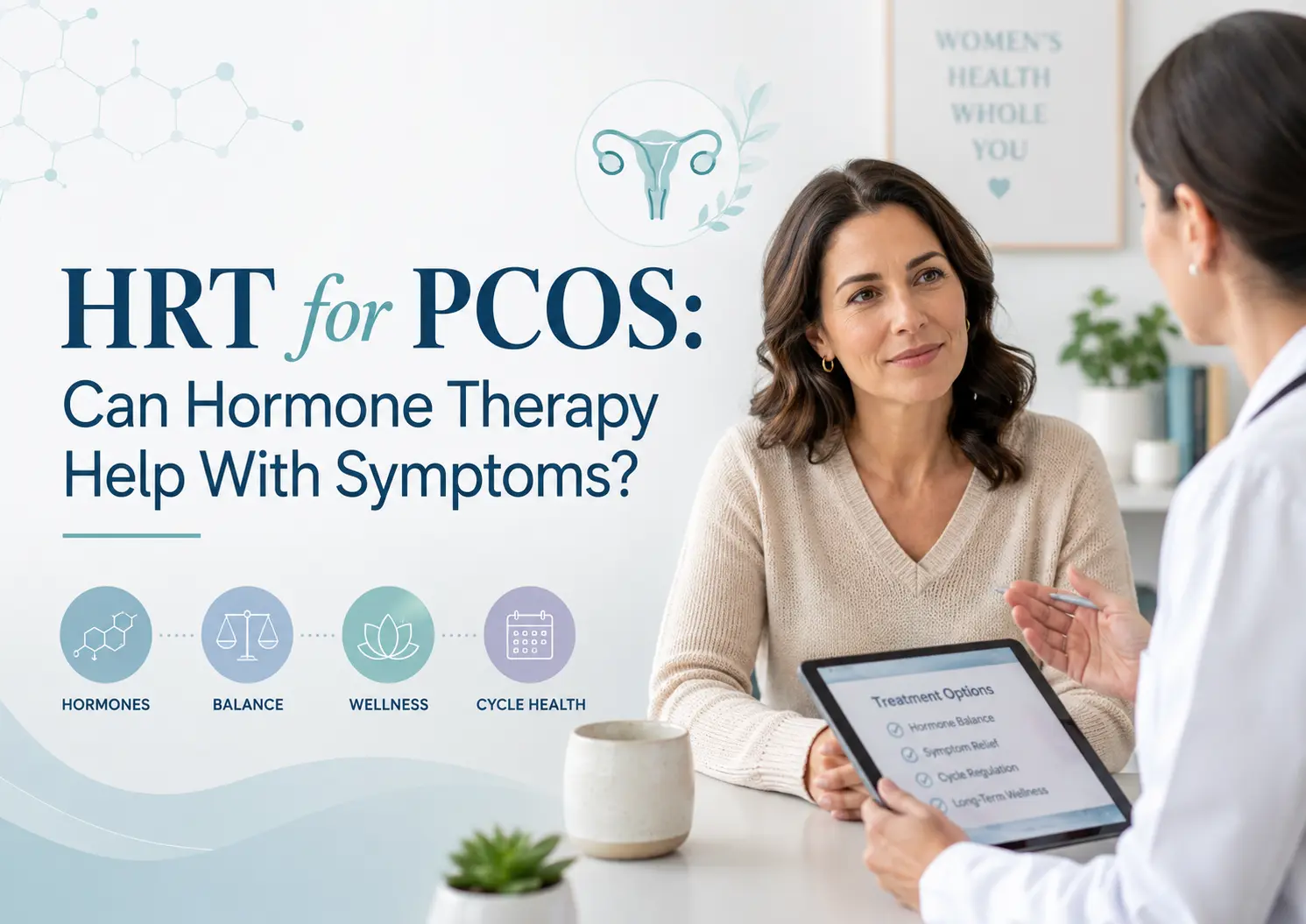
If you have PCOS and keep seeing people talk about HRT, hormone therapy, progesterone, estrogen, birth control, or “balancing hormones,” it can get confusing fast.
Some people use the term HRT to mean menopause hormone replacement therapy.
Others use it more broadly to describe any treatment that affects estrogen, progesterone, testosterone, or other hormones.
With PCOS, that difference matters.
HRT for PCOS may help some people, but the right approach depends on your age, symptoms, cycle pattern, hormone levels, health history, and whether you are trying to get pregnant.
For many reproductive-age women with PCOS, the treatment is not classic menopause HRT.
It may involve combined hormonal birth control, cyclic progesterone or progestin, metabolic care, anti-androgen support, lifestyle changes, or a personalized hormone-balancing plan.
For women in perimenopause or menopause, HRT may be considered for symptoms like hot flashes, night sweats, sleep changes, vaginal dryness, mood shifts, and low estrogen symptoms.
If you also have PCOS, your provider should look at the full picture, including androgen levels, insulin resistance, cardiovascular risk, uterine health, and how your symptoms have changed over time.
At Amari Health in Scarsdale, NY, PCOS care is not about guessing which hormone is “off.”
It is about understanding why your symptoms are happening and building a plan around your body, your labs, and your goals.
SEE HOW HRT CAN HELP YOU
Quick Answer: Can HRT Help PCOS?
HRT may help some people with PCOS, but it depends on what symptoms are being treated.
For reproductive-age women, hormone therapy often means birth control pills, cyclic progesterone, or progestin therapy rather than classic menopause HRT.
For women in perimenopause or menopause, HRT may help low-estrogen symptoms, but PCOS-related androgen and metabolic issues still need to be addressed.
Hormone therapy may be useful for irregular periods, uterine lining protection, acne, unwanted hair growth, and some menopause-related symptoms.
However, PCOS is not only an estrogen or progesterone issue.
It can also involve high androgens, irregular ovulation, insulin resistance, inflammation, weight changes, and long-term metabolic risk.
That is why the best treatment plan starts with a full evaluation, not a guess.
What Is PCOS?
PCOS stands for polycystic ovary syndrome.
Some medical sources are beginning to use the term polyendocrine metabolic ovarian syndrome, or PMOS, because the condition often involves more than the ovaries.
It can affect hormones, metabolism, skin, hair, weight, mood, cycles, and long-term health risk.
Many patients and providers still use the term PCOS, so that is the term used throughout this article.
Mayo Clinic now refers to the condition as PMOS while noting the same pattern of hormone imbalance, irregular periods, and ovarian changes.
PCOS is commonly associated with irregular periods, missed periods, heavy or unpredictable bleeding, acne, oily skin, excess facial or body hair, scalp hair thinning, weight gain, difficulty losing weight, insulin resistance, fatigue, mood changes, trouble with ovulation, and fertility challenges.
Not every person with PCOS has ovarian cysts, and not every person has the same symptoms.
One woman may mainly struggle with irregular periods and acne.
Another may have normal-looking skin but significant insulin resistance and weight changes.
Another may not realize she has PCOS until she starts trying to conceive.
That is why PCOS treatment should not be one-size-fits-all.
How PCOS Is Diagnosed Before Hormone Treatment
Before talking about HRT for PCOS, it helps to confirm what is actually being treated.
PCOS is usually diagnosed by looking at symptoms, cycle patterns, androgen signs or lab results, and sometimes ultrasound findings.
Providers may also run tests to rule out other conditions that can cause similar symptoms, such as thyroid disorders, high prolactin, adrenal conditions, or other hormone changes.
A proper evaluation may include:
- Cycle history
- Bleeding patterns
- Acne, hair growth, or hair thinning patterns
- Weight and metabolic history
- Pregnancy goals
- Testosterone and other androgen markers
- Thyroid testing
- A1C, glucose, and insulin markers
- Cholesterol
- Blood pressure
- Medication and supplement review
This step matters because irregular periods, acne, weight gain, fatigue, mood changes, and hair thinning can come from more than one cause.
Starting hormones without understanding the bigger picture can make it harder to know what is helping and what still needs attention.
What Does “HRT for PCOS” Actually Mean?
This is where many people get stuck.
“HRT” usually stands for hormone replacement therapy.
In standard medical use, HRT often refers to estrogen, progesterone, or a combination of hormones used during perimenopause or menopause when natural hormone levels decline.
But online, many people use HRT more loosely.
They may use it to describe birth control pills, progesterone therapy, bioidentical hormones, testosterone therapy, or general hormone-balancing treatment.
With PCOS, those are not all the same thing.
Menopause HRT
Menopause HRT is usually used when estrogen levels have declined and symptoms are interfering with quality of life.
It may involve estrogen alone or estrogen with progesterone, depending on whether a woman still has her uterus.
Combined Hormonal Birth Control
Combined hormonal birth control contains estrogen and progestin.
In PCOS, it is often used to regulate periods, reduce androgen activity, help acne, and lower excess hair growth over time.
Cyclic Progesterone or Progestin Therapy
Some women with PCOS do not ovulate regularly.
When ovulation does not happen, progesterone may remain low or inconsistent.
Cyclic progesterone or progestin therapy may be used to trigger more predictable bleeding and help protect the uterine lining.
One study noted that progestin therapy can help regulate periods and protect against endometrial cancer, but it does not improve androgen levels or prevent pregnancy.
Bioidentical Hormone Therapy
Bioidentical hormones are designed to be structurally similar to hormones made by the body.
Some women ask about bioidentical hormone therapy for PCOS because they want a more personalized approach than standard birth control.
Whether this makes sense depends on your symptoms, hormone levels, cycle pattern, and safety profile.
Bioidentical does not automatically mean right for every person.
It still needs to be monitored carefully.
Testosterone Therapy
Testosterone is already often elevated in PCOS.
Because of that, testosterone therapy is not usually the answer for reproductive-age women with androgen-dominant PCOS symptoms like acne, facial hair growth, or scalp hair thinning.
There are exceptions in specific settings, such as certain menopause cases or gender-affirming care, but this needs careful medical evaluation.
HRT vs Birth Control vs Progesterone for PCOS
Many people ask whether HRT and birth control are the same thing.
They are related, but they are not identical.
| Option |
Common Use in PCOS |
May Help With |
Does It Prevent Pregnancy? |
| Combined hormonal birth control |
Cycle regulation and androgen symptoms |
Irregular periods, acne, unwanted hair growth, uterine lining protection |
Yes |
| Cyclic progesterone or progestin |
More predictable bleeding and uterine lining protection |
Infrequent or absent periods |
Not always |
| Menopause HRT |
Perimenopause or menopause symptoms |
Hot flashes, night sweats, sleep issues, vaginal dryness, low estrogen symptoms |
No |
| Metformin |
Metabolic support |
Insulin resistance, blood sugar patterns, metabolic health, sometimes ovulation support |
No |
| Anti-androgen medication |
Androgen-related symptoms |
Acne, facial hair growth, scalp hair thinning |
No, but pregnancy prevention is usually discussed because of fetal risk |
The right option depends on your symptoms and goals.
If you are trying to prevent pregnancy and manage acne, one option may make sense.
If you are trying to conceive, that same option may not fit your goal.
If you are in menopause and dealing with hot flashes, your plan will be different again.
How PCOS Affects Estrogen, Progesterone, Testosterone, and Insulin
PCOS is often described as a hormone imbalance, but that phrase can be too vague.
The main hormone and metabolic patterns may include high androgens, irregular ovulation, inconsistent progesterone, insulin resistance, and altered estrogen-progesterone signaling.
Testosterone and Other Androgens
Androgens are hormones such as testosterone and DHEA-S.
Everyone has androgens, but in PCOS, they may be elevated or more active than normal.
High androgen activity may contribute to acne, oily skin, facial hair growth, body hair growth, scalp hair thinning, and irregular ovulation.
Lowering androgen effects is one reason combined hormonal contraceptives and anti-androgen medications are sometimes used in PCOS care.
Progesterone and Irregular Ovulation
Ovulation is when the ovary releases an egg.
If you do not ovulate regularly, your periods may become irregular, delayed, absent, or unpredictable.
Irregular ovulation can also affect progesterone.
Progesterone usually rises after ovulation.
If ovulation does not happen consistently, progesterone may not rise in a steady pattern.
This is one reason some women with PCOS are prescribed cyclic progesterone or progestin therapy.
Estrogen and the Uterine Lining
PCOS does not always mean estrogen is low.
Some women with PCOS may have ongoing estrogen exposure without regular progesterone-driven shedding of the uterine lining.
When periods are very infrequent, the uterine lining may build up over time.
This is one reason providers often take irregular or absent periods seriously in PCOS care.
Insulin Resistance
Many people with PCOS have insulin resistance.
This means the body has to produce more insulin to keep blood sugar regulated.
High insulin can worsen androgen production and make weight management more difficult.
This is why PCOS care often includes nutrition, movement, sleep, stress support, and sometimes medication aimed at metabolic health.
How Hormone Therapy May Help PCOS Symptoms
Hormone therapy may help certain PCOS symptoms, especially when symptoms are related to irregular cycles, androgen activity, or low estrogen during perimenopause or menopause.
It is not usually the whole answer by itself.
| PCOS Concern |
Could Hormone Therapy Help? |
What Else May Need Attention? |
| Irregular periods |
Yes, in some cases |
Ovulation, uterine lining health, progesterone patterns |
| Acne |
Sometimes |
Androgens, inflammation, skin care, medication options |
| Facial hair growth |
Sometimes |
Androgens, hair removal, anti-androgen support |
| Hair thinning |
Sometimes, depending on the cause |
Testosterone, DHT sensitivity, thyroid, iron, nutrition |
| Weight gain |
Not usually as a stand-alone treatment |
Insulin resistance, metabolic health, sleep, nutrition, muscle mass |
| Fertility |
Not usually as the main treatment |
Ovulation support, metabolic health, fertility planning |
| Perimenopause symptoms |
Possibly |
Estrogen decline, progesterone, sleep, mood, metabolic risk |
| Menopause symptoms |
Possibly |
Low estrogen symptoms, uterine protection, personal risk factors |
Irregular Periods
Irregular periods are one of the most common reasons people with PCOS ask about hormone therapy.
Depending on your situation, a provider may consider combined hormonal birth control, cyclic progesterone, progestin therapy, or another strategy to create more predictable bleeding.
This can help reduce the stress of not knowing when your period will come.
It may also support uterine lining protection when periods are very infrequent.
However, regulating bleeding is not the same as fixing every part of PCOS.
You may still need support for insulin resistance, inflammation, thyroid function, stress, sleep, or androgen-related symptoms.
Acne and Oily Skin
PCOS-related acne is often connected to androgen activity.
Hormone therapy that lowers androgen effects may help some women see fewer breakouts over time.
This usually takes patience.
Skin changes often take several months to respond.
If acne is severe, painful, or persistent, your provider may also discuss dermatology support, nutrition, gut health, inflammation, stress, or other medication options.
Facial Hair or Excess Body Hair
Excess hair growth, also called hirsutism, is another common androgen-related symptom.
Combined hormonal contraceptives may help reduce androgen activity, but hair growth changes slowly.
Existing coarse hair may not disappear on its own.
Some women also need hair removal treatments, anti-androgen medication, or additional hormone evaluation.
Australian Prescriber notes that the combined oral contraceptive pill is commonly used as first-line pharmacological therapy for irregular periods and clinical hyperandrogenism, including hirsutism and acne.
Hair Thinning
Scalp hair thinning in PCOS is often related to androgen sensitivity.
This is different from general shedding due to stress, thyroid issues, low iron, low protein intake, illness, or rapid weight loss.
If hair thinning is one of your main symptoms, it is important to look deeper than estrogen and progesterone.
Your provider may want to assess androgens, thyroid function, iron status, nutrition, stress, medication history, and scalp health.
Weight Gain or Difficulty Losing Weight
HRT is not a primary weight-loss treatment for PCOS.
Weight changes in PCOS are often connected to insulin resistance, blood sugar regulation, inflammation, sleep quality, stress hormones, nutrition, muscle mass, and activity level.
Hormone support may be part of a broader plan if your labs and symptoms point in that direction, but it should not be presented as a stand-alone fix for PCOS-related weight gain.
At Amari Health, this is where a whole-body approach matters.
If your hormones, blood sugar, gut health, stress response, and inflammation are all influencing each other, treating only one piece may not give you the results you want.
Mood, Sleep, and Fatigue
PCOS can affect how you feel day to day.
Some women experience anxiety, irritability, low mood, poor sleep, fatigue, or brain fog.
These symptoms may come from several overlapping issues, including hormone fluctuations, insulin resistance, inflammation, blood sugar swings, poor sleep quality, nutrient deficiencies, thyroid dysfunction, high stress, or perimenopause.
Hormone therapy may help if symptoms are connected to estrogen or progesterone changes, but it should be guided by a proper evaluation rather than symptoms alone.
HRT for PCOS Before Menopause: What to Know
For women who are still in their reproductive years, “HRT for PCOS” usually does not mean replacing hormones lost to menopause.
Instead, treatment often focuses on regulating periods, reducing androgen symptoms, protecting the uterine lining, supporting ovulation if pregnancy is desired, improving insulin sensitivity, supporting weight and metabolic health, reducing acne or unwanted hair growth, and lowering long-term risks connected to PCOS.
In this stage, your provider may talk about combined hormonal contraception, cyclic progesterone, progestin therapy, metformin, anti-androgen medication, nutrition, strength training, sleep support, stress management, or fertility-focused care.
The right plan depends on your main goal.
If you want fewer breakouts and more predictable periods, your plan may look different than someone who is trying to conceive.
If your biggest concern is weight gain and insulin resistance, your plan may look different than someone whose main symptom is heavy bleeding.
That is why testing and context matter.
HRT for PCOS During Perimenopause
Perimenopause can be especially confusing for women with PCOS.
PCOS can already cause irregular periods, mood changes, sleep problems, weight changes, and hair concerns.
Perimenopause can cause many of those same symptoms.
That means you may wonder: is this my PCOS, perimenopause, or both?
During perimenopause, estrogen and progesterone can fluctuate.
Periods may become more unpredictable.
Sleep may worsen.
Anxiety, irritability, hot flashes, night sweats, vaginal dryness, lower libido, and brain fog may appear.
If you have PCOS, androgen symptoms and insulin resistance may still be part of the picture.
You may also notice that weight feels harder to manage, especially around the midsection.
In this stage, HRT may be considered for perimenopause symptoms, but your provider should also assess PCOS-related risks and patterns.
A thoughtful plan may include hormone testing, metabolic testing, nutrition support, strength training, sleep support, and symptom tracking.
HRT for PCOS After Menopause: Can You Take It?
PCOS does not always simply disappear after menopause.
Some symptoms may shift.
Periods stop, so irregular cycles are no longer the main concern.
But androgen-related hair changes, weight changes, insulin resistance, cholesterol concerns, and cardiovascular risk may still matter.
After menopause, HRT may be considered for symptoms such as hot flashes, night sweats, poor sleep, mood changes, vaginal dryness, pain with intercourse, low libido, brain fog, joint discomfort, and other low-estrogen symptoms.
If a woman still has her uterus, estrogen therapy is usually paired with progesterone or a progestogen to protect the uterine lining.
That decision should be made with a qualified provider after reviewing personal risk factors.
For women with a history of PCOS, menopause hormone therapy should be personalized.
The goal is not just to replace estrogen.
It is to understand the full hormonal and metabolic picture.
Can HRT Help PCOS Fertility?
HRT is not usually the main fertility treatment for PCOS.
If you are trying to get pregnant, the focus is usually on ovulation, egg release, metabolic health, and cycle timing.
Some hormone therapies may prevent ovulation while you are taking them, which means they would not be used when actively trying to conceive.
Mayo Clinic lists options such as letrozole, clomiphene, metformin, and gonadotropins among treatments that may be considered when the goal is ovulation or pregnancy.
That does not mean hormones are irrelevant.
It means the plan needs to match the goal.
If you have PCOS and want to get pregnant now or in the near future, tell your provider before starting any hormone therapy. Fertility goals should shape the treatment plan from the beginning.
Is HRT Safe If You Have PCOS?
HRT or hormone therapy can be appropriate for some people with PCOS, but it is not right for everyone.
A provider should review factors such as:
- Personal or family history of blood clots
- Migraine with aura
- Smoking status
- Blood pressure
- Cholesterol
- Liver disease
- History of hormone-sensitive cancer
- Unexplained vaginal bleeding
- Pregnancy goals
- Uterine health
- Weight and metabolic risk
- Current medications
- Age and menopause status
This does not mean you should be afraid of hormone therapy.
It means hormones should be used with a clear reason, proper testing, and follow-up.
PCOS is already complex.
Adding hormones without understanding your baseline can make it harder to know what is helping, what is not, and what needs to change.
What Should Be Checked Before Considering HRT for PCOS?
Before starting hormone therapy for PCOS, it helps to understand what is happening in your body.
Depending on your symptoms, your provider may evaluate:
- Cycle history
- Bleeding patterns
- Acne, hair growth, or hair loss patterns
- Pregnancy goals
- Current medications and supplements
- Blood pressure
- Family and personal health history
- Testosterone and other androgen markers
- Estrogen and progesterone patterns
- Thyroid markers
- A1C and glucose
- Fasting insulin
- Cholesterol
- Inflammation markers when appropriate
- Nutrient status when relevant
- Stress, sleep, and lifestyle factors
At Amari Health, PCOS care is built around personalized evaluation.
Amari’s PCOS page describes care that uses clinical therapies and lifestyle optimization to address hormonal imbalances, with personalized care aimed at supporting hormone balance.
That type of approach matters because two women can both have PCOS and need very different care.
One may need help with insulin resistance.
Another may need androgen support.
Another may need progesterone support for irregular cycles.
Another may need perimenopause care.
Another may need fertility-focused treatment.
The diagnosis may be the same, but the plan should not be copied and pasted.
SEE IF HRT IS RIGHT FOR YOU
What to Ask Your Provider Before Starting HRT for PCOS
Before starting HRT or hormone therapy for PCOS, it helps to ask direct questions.
Ask what type of hormone therapy is being recommended and why.
Ask whether the goal is to regulate bleeding, reduce androgen symptoms, protect the uterine lining, support menopause symptoms, or address something else.
You may also want to ask:
- Will this help my specific symptoms?
- Will this affect ovulation or pregnancy?
- Does this address insulin resistance?
- Do I need progesterone for uterine protection?
- What labs should be checked first?
- How long should it take to notice changes?
- What side effects should I watch for?
- How will we know if the plan is working?
- What happens if I want to stop?
A clear treatment plan should explain the reason for the therapy, what it is expected to help, what it will not fix, and how your provider will monitor your response.
PCOS Hormone Care in Scarsdale, NY
If you are looking for PCOS and hormone therapy in Scarsdale, NY, or the Westchester County area, Amari Health takes a root-cause approach to PCOS, hormone imbalance, and metabolic health.
Instead of looking at one symptom in isolation, the team considers how hormones, insulin, inflammation, gut health, lifestyle, sleep, stress, and aging may be interacting.
For women in Scarsdale, Westchester County, and the surrounding New York area, Amari Health offers personalized care for PCOS issues, hormone symptoms, perimenopause, menopause, weight concerns, fatigue, and related symptoms.
This can be especially helpful if you have been told to “just lose weight,” “just take birth control,” or “everything looks normal,” even though you still do not feel like yourself.
CONTACT US
The Bottom Line on HRT for PCOS
HRT for PCOS is not a simple yes-or-no topic.
Hormone therapy may help some people with PCOS, especially when the goal is to regulate bleeding, protect the uterine lining, reduce androgen-related symptoms, or manage perimenopause and menopause symptoms.
But PCOS is not only an estrogen or progesterone problem.
It can involve androgens, insulin resistance, inflammation, ovulation issues, stress, sleep, thyroid health, gut health, and long-term metabolic risk.
The best plan depends on your body, your symptoms, your labs, your age, and your goals.
If you are considering HRT for PCOS, the safest next step is not to guess.
It is to get a full evaluation and work with a provider who understands both hormone health and the broader metabolic picture.
Amari Health helps women take a more personalized approach to PCOS and hormone imbalance, with care designed to uncover what your body is trying to tell you and build a plan that supports long-term wellness.
SCHEDULE A CONSULTATION
FAQs
Can HRT help PCOS?
HRT or hormone therapy may help some PCOS symptoms, especially irregular bleeding, uterine lining protection, acne, unwanted hair growth, and perimenopause or menopause symptoms. The right approach depends on your age, cycle pattern, hormone levels, symptoms, health history, and pregnancy goals.
Is HRT the same as birth control for PCOS?
No. Many people use the term HRT loosely, but birth control and menopause HRT are different. Combined hormonal birth control may be used in reproductive-age women with PCOS to regulate cycles and reduce androgen symptoms. Menopause HRT is usually used when estrogen levels decline during perimenopause or menopause.
Does progesterone help PCOS?
Progesterone or progestin therapy may help some women with PCOS have more predictable bleeding and protect the uterine lining when periods are infrequent. However, progesterone alone usually does not lower androgen symptoms such as acne, facial hair growth, or scalp hair thinning.
Does estrogen help PCOS?
Estrogen-containing therapy may help some PCOS symptoms when used as part of combined hormonal contraception. It may help regulate bleeding and reduce androgen activity. In menopause, estrogen therapy may help low-estrogen symptoms such as hot flashes, night sweats, sleep problems, and vaginal dryness. It should be personalized and monitored by a provider.
Can HRT help PCOS weight gain?
HRT is not a primary weight-loss treatment for PCOS. PCOS-related weight changes are often tied to insulin resistance, blood sugar regulation, inflammation, sleep, stress, nutrition, and muscle mass. Hormone support may be one part of care if indicated, but metabolic health usually needs to be addressed directly.
Can PCOS symptoms continue after menopause?
Yes, some PCOS-related concerns can continue after menopause, especially androgen-related hair changes, weight changes, insulin resistance, cholesterol concerns, and metabolic risk. Period irregularity is no longer a symptom after menopause, but the broader hormone and metabolic picture can still matter.
You may want to discuss hormone replacement therapy with a healthcare provider if hot flashes, night sweats, disrupted sleep, vaginal dryness, painful sex, mood changes, or other perimenopause or menopause symptoms are affecting your comfort or daily life. These symptoms do not automatically mean that you need HRT, since the right treatment depends on their severity, your health history, personal risk factors, and preferences.