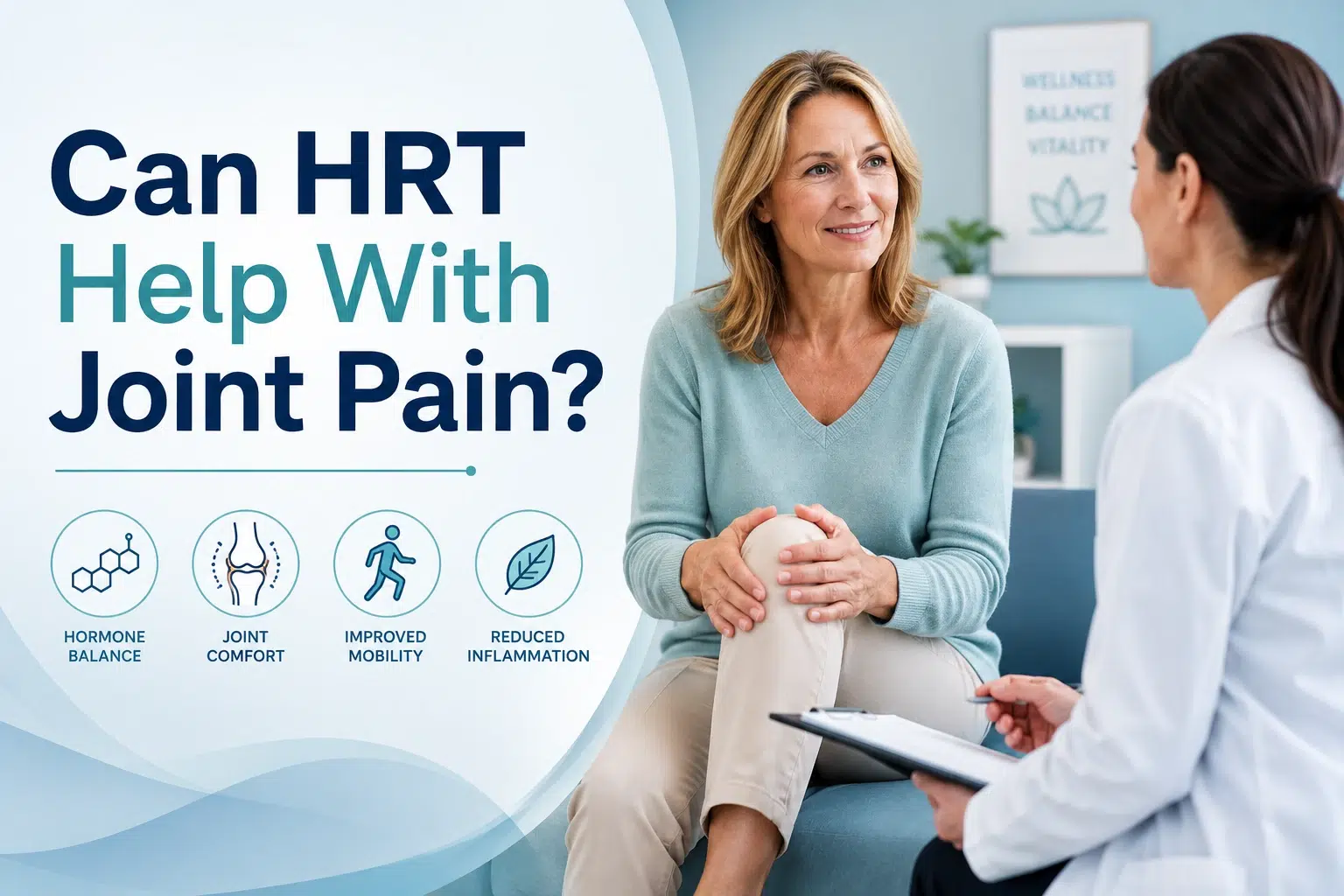
Can HRT Help With Joint Pain?
- HRT
- Share this post on:
- Share this post on:
Post Contents
Estrogen loss during menopause increases joint inflammation and cartilage breakdown, and research shows HRT can modestly reduce joint pain for many women, though evidence is mixed and results vary from person to person.
The best HRT for joint pain usually combines steady-dose delivery, like a patch, gel, or pellet, with personalized dosing based on real hormone testing.
Most women notice a difference within one to three months.
Why Does Menopause Cause Joint Pain?
Joints contain estrogen receptors, and when estrogen levels drop during perimenopause and menopause, joints lose some of their natural protection against inflammation and cartilage breakdown.
That’s why so many women suddenly notice new stiffness, aching, or swelling in their knees, hands, hips, and shoulders around this time in life.
More than 2 in 5 women experience joint or muscle pain in the years leading up to menopause and during the transition itself.
Researchers who study what’s now called musculoskeletal syndrome of menopause have found that more than 70% of women experience some kind of musculoskeletal symptom during this transition, and roughly one in four become disabled by it at some point.
Estrogen isn’t just involved in reproduction.
It helps keep joints lubricated by supporting the fluid that cushions them, and it plays a direct role in cartilage health.
Estrogen supports collagen production in cartilage and helps block the enzymes that break it down, so when estrogen falls, that protection fades and inflammation can take over.
Falling estrogen also triggers a rise in inflammatory chemicals throughout the body, which can make joints feel puffy, tender, and stiff, especially first thing in the morning.
Can HRT Help With Joint Pain?
For many women, yes.
Hormone replacement therapy can reduce how often and how severely joints ache during menopause, though the effect is usually modest rather than a complete fix, and not every woman responds the same way.
The strongest evidence comes from the Women’s Health Initiative, a large randomized trial that followed more than 10,700 postmenopausal women.
That benefit held up through year three of the study.
What the Research Actually Shows
Not every study agrees on how much HRT actually helps.
A 2025 review pooled data from 57 studies covering nearly 4 million women and found the overall evidence too mixed to draw firm conclusions about hormone therapy’s effect on joint pain.
Effect sizes were generally modest, and the clearest benefit showed up in preventing new joint symptoms from developing, rather than reversing pain that had already set in.
That doesn’t mean HRT won’t help you.
It means results vary depending on your hormone levels, how long you’ve been in menopause, and what’s actually driving your joint pain.
Joint pain has more than one possible cause, including osteoarthritis, autoimmune conditions, and ordinary wear and tear, and hormone therapy only addresses the piece connected to estrogen loss.
What Is the Best HRT for Joint Pain?
There’s no single hormone regimen that works best for every woman, but certain combinations and delivery methods tend to show up more often in women who get real relief from joint symptoms.
Estrogen-Only vs. Combined Estrogen-Progesterone Therapy
Women who still have a uterus typically need estrogen paired with progesterone to protect the uterine lining, while women who’ve had a hysterectomy can often take estrogen alone.
Some women also benefit from adding testosterone to the mix, since it supports muscle strength around the joints in addition to estrogen’s role in reducing inflammation.
Getting the dose, duration, and delivery route right for each woman’s specific symptoms matters as much as which hormones she takes, which is one reason a standard starting prescription doesn’t work equally well for everyone.
Why Delivery Method (Patch, Gel, or Pellet) Matters
How you take HRT can matter just as much as which hormones you take.
Oral pills pass through the liver and can cause hormone levels to rise and fall throughout the day, while patches, gels, and pellets release hormones more steadily through the skin.
That steadier release is one reason transdermal and pellet-based options are often preferred for joint-related symptoms specifically.
Consistent hormone levels tend to translate into more consistent relief from stiffness and inflammation, rather than the peaks and dips that can come with a daily pill.
- Patches: worn on the skin and changed once or twice a week, providing steady hormone release.
- Gels or creams: applied daily, also transdermal, and easy to adjust as your dose needs change.
- Pellets: inserted under the skin and release hormones gradually over several months.
- Oral pills: convenient, but create more fluctuation in hormone levels throughout the day.
How Amari Health Helps Women Find Relief From Menopausal Joint Pain
Guessing at a hormone dose rarely works well, and it’s part of why so many women feel like HRT “didn’t work” for them when the real issue was the starting point.
At Amari Health, we begin by checking your hormone levels and running advanced diagnostic testing that looks at inflammation markers, thyroid function, and other factors that can contribute to joint pain alongside declining estrogen.
From there, we build a hormone plan around your actual numbers and symptoms, not a standard starting dose.
That might mean bioidentical estrogen delivered through a patch or pellet, added testosterone, or a different starting point entirely, depending on what your testing shows.
It’s a functional medicine approach to menopause that treats joint pain as one piece of a bigger picture, rather than an isolated symptom to mask.
We see women in person at our practice in Scarsdale, and provide hormone therapy for women across New York and Connecticut, with ongoing coaching support available by telehealth between visits.
How Long Does It Take for HRT to Relieve Joint Pain?
Most women who respond to HRT for joint pain notice a difference within one to three months of starting treatment.
Some feel improvement sooner, especially with steady-release delivery methods, while others need a dose adjustment before symptoms meaningfully improve.
Joint pain tends to improve more gradually than symptoms like hot flashes, which can ease within days or weeks.
Because joint tissue and inflammation levels change slowly, it takes longer for hormone therapy’s anti-inflammatory effects to show up as less stiffness and pain.
If you don’t notice any change after a few months, it’s worth exploring how long it typically takes to feel a difference on HRT and whether your dose or delivery method needs adjusting.
What If HRT Doesn’t Fully Resolve Your Joint Pain?
If joint pain doesn’t improve on HRT, the cause may not be fully hormonal, your current dose or delivery method may not be right for you, or another condition like osteoarthritis or an autoimmune disorder could be playing a role.
The first step is figuring out whether your current HRT dose is actually high enough to address your symptoms.
Many women start on a conservative dose that works well for hot flashes but isn’t enough to meaningfully reduce joint inflammation.
Strength training and an anti-inflammatory diet can also make a real difference alongside HRT, since building muscle around a joint takes pressure off it and reduces strain.
If pain persists despite dose adjustments and lifestyle changes, it’s worth ruling out other causes, since joint pain unrelated to hormones won’t respond to hormone therapy no matter how well it’s dosed.
Is HRT Safe for Joint Pain Relief?
For most women under 60 or within 10 years of menopause, hormone therapy is considered safe when personalized to their health history, and the benefits typically outweigh the risks.
Like any medication, it does carry some risk, including a small increased risk of blood clots and, for certain regimens, breast cancer.
Age and time since menopause both affect that risk profile, which is why testing and a real conversation with a provider matter more than following a generic protocol.
Joint pain and osteoarthritis risk both increase in women after age 50, right around the same time menopause-related hormone changes accelerate, so ongoing joint pain isn’t something to just accept as inevitable.
Signs You May Be a Candidate for HRT
Joint pain alone doesn’t necessarily mean you need HRT, but when it shows up alongside other menopause symptoms, it’s worth a closer look.
- Hot flashes or night sweats
- Irregular or missed periods
- New or worsening joint stiffness, especially in the morning
- Trouble sleeping or new sleep disruption
- Mood changes, brain fog, or low energy
- Vaginal dryness or discomfort
If you’re noticing several of these together, it’s a good sign your joint pain may be connected to hormone changes rather than a separate issue.
You can review the full list of signs you may need hormone replacement therapy to see how your symptoms compare.
Joint pain doesn’t have to be something you just live with through menopause.
If it’s new, it’s worsening, or it’s showing up alongside other symptoms, it’s worth finding out what’s actually driving it instead of guessing.
Amari Health specializes in figuring out the real cause behind symptoms like this, then building a hormone plan around your actual numbers, not a one-size-fits-all dose.
FAQs: Can HRT Help With Joint Pain
Can HRT help with joint pain?
For many women, yes. Research shows hormone therapy can reduce how often and how severely joints ache during menopause, though the effect is usually modest and depends on the underlying cause of the pain.
What is the best HRT for joint pain?
There’s no single best option for everyone, but transdermal patches, gels, and pellets tend to provide steadier hormone levels than oral pills, and some women benefit from adding testosterone alongside estrogen for extra support around the joints.
How long does HRT take to help joint pain?
Most women who respond to HRT notice a difference within one to three months, though joint pain typically improves more slowly than symptoms like hot flashes.
Does HRT help with joint pain if I already have arthritis?
HRT may ease some of the inflammation that comes with hormone changes, but it isn’t a treatment for osteoarthritis itself. Women with existing arthritis often need a combination of hormone therapy, physical therapy, and other joint-specific care.
Can joint pain come back if I stop HRT?
It’s possible. Since HRT works by addressing estrogen-related inflammation, joint pain can return if estrogen levels drop again after stopping treatment, though how much it comes back varies from person to person.
What other menopause symptoms does HRT help besides joint pain?
HRT is most well known for easing hot flashes, night sweats, and vaginal dryness, and it can also help protect bone density and reduce fracture risk in the years after menopause.

Not Sure Where to Start?
Lorem ipsum dolor sit amet consectetur. Et ultrices nunc donec placerat. In velit mattis ac arcu vitae tortor ullamcorper.